
Protecting Michigan’s Most Vulnerable
Oversight and reform for children’s mental health services
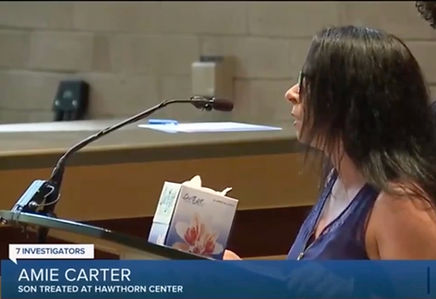
Amie Carter testifies at the Protect MI Kids listening session
Summary
-
The Hawthorn Center, Michigan’s only state-run psychiatric hospital for children, faced scrutiny after reports of neglect, mistreatment, and safety concerns.
-
Senator Webber called for oversight hearings and an audit to assess the issues and hold the state accountable.
-
Senator Webber introduced a package of bills to address the audit findings, focusing on improving oversight, accountability, and safeguarding patient rights within the state’s mental health services.
Background: A Crisis Comes to Light
In Michigan, children needing intensive inpatient psychiatric care are referred to the Hawthorn Center, the only state-run psychiatric hospital for children. Its mission is to provide specialized care and support to children facing severe mental health challenges.
When parents enroll their children at the Hawthorn Center, they are entrusting the state with their most precious loved ones, in hopes of receiving life-changing intervention. For decades, Hawthorn Center provided quality, compassionate care for children. It was a facility families trusted—until they couldn’t.
What Went Wrong at Hawthorn Center
In 2022, troubling news began to emerge from the Hawthorn Center. A poorly planned, unannounced active shooter drill terrified patients and staff, exposing questionable judgment by hospital management. An already vulnerable population was traumatized once again. The catastrophic event prompted deeper investigation, which uncovered a disturbing pattern of multiple escape attempts by young patients.
Further claims of neglect and mistreatment deepened the alarming narrative surrounding the Hawthorn Center. As more incidents were reported, more families came forward. One conclusion became undeniable: the hospital was failing in its duty of care, and the state was failing to respond.
The Action Plan: Investigation and Reform
What Went Wrong at Hawthorn Center
Senator Webber heard the outcry from patients and their families and refused to let their concerns be brushed aside. He called for oversight hearings on MDHHS failures at Hawthorn Center, telling Senate leaders, “It is clear that there are issues at Hawthorn that require us to understand what is going wrong.”
He invited parents to come forward and hosted the Protect MI Kids listening session, where families voiced their concerns to legislators. It became apparent that the facility was not meeting patients’ needs and, in some cases, was making their problems worse. Numerous incidents were uncovered, and many complaints had been inadequately addressed or ignored.
How Lawmakers Responded to the Crisis
The plan from the listening session had two key components: a comprehensive independent audit to identify the system’s deficiencies and legislative reforms to drive necessary changes.
Webber formally requested a state audit by the Office of the Auditor General (OAG) to provide a clear assessment of the crisis at Hawthorn, which was essential to finding a solution.
"Michael Webber listened to families. He pushed for answers. He requested the audit that exposed these failures, and he has continued fighting for accountability and real reform."
Amie Carter, Son treated at Hawthorn Center
What the Audit Revealed
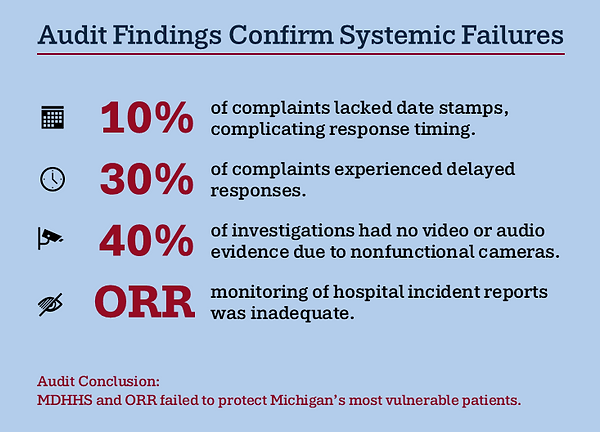
When the audit findings were released, they showed the state was failing to protect the rights of patients receiving mental health care. The patients’ families felt vindicated.
The audit confirmed their claims that the Office of Recipient Rights (ORR), the entity tasked with protecting patients, was not meeting the established standards. It also laid the groundwork for necessary legislative reform.
New Laws to Protect Vulnerable Children
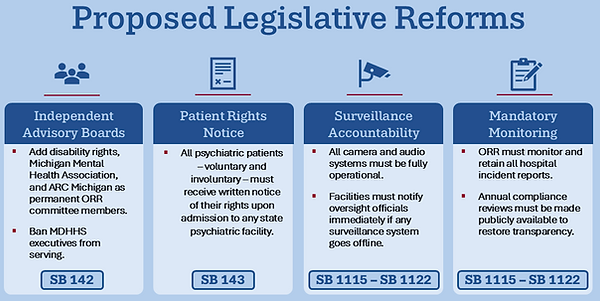
Senator Webber turned the audit findings into an eight-bill package to ensure that a crisis like this does not happen again. The legislation focused on reforming the flawed system by introducing independent advisory boards, patient rights notifications, accountability in surveillance, and mandatory ORR monitoring to strengthen oversight and protect patients.
Key measures included Senate Bills 1048 and 1049, which sought to strengthen ORR independence by including advocacy organizations in the Recipient Rights Advisory Committee and ensuring voluntary psychiatric patients receive written notifications of their rights.
Building a Safer Future for Michigan’s Kids
Senator Webber’s legislation is a significant step in improving Michigan’s mental health care system and protecting vulnerable patients. The audit stands as a remarkable achievement, uncovering hidden issues that needed attention and paving the way for much-needed reforms.
Senator Webber is committed to rebuilding public confidence: “I’ve heard heartbreaking stories from families who believed the system would protect their loved ones but instead felt abandoned. These reforms are about restoring trust, making sure complaints are taken seriously, and providing families peace of mind by knowing someone is watching out for those who can’t always protect themselves.”